Reviewing Energy Storage Inverter Manufacturers: questions about requirement screening for shortlisting to settle before an RFQ
Comparing energy storage inverter manufacturers is more useful when the requirements are fixed before the shortlist is built. Technical buyers should first describe the intended application, operating modes, power range, system architecture, and site constraints. This prevents a broad product search from becoming an unsupported ranking exercise.

Set criteria before comparing candidates
Start with the project decision, not the supplier name. Define whether the system needs a bidirectional converter, a microgrid hybrid inverter, or another form of power conversion equipment. Then record the required power band and the operating behavior that matters. A requirement may involve grid-connected operation, islanded operation, source management, or a particular control mode.
Space and integration also belong in the first screening pass. Record the available installation area, the planned system capacity, and the connections that the design must accommodate. Keep these as project requirements rather than assumptions about a product. A model may appear close to the target on power alone while remaining unsuitable for the wider system design.
Use a simple pass, open point, or not demonstrated status for every requirement. “Pass” means the captured evidence directly addresses the requirement. “Open point” means the requirement may be relevant, but the available page does not settle it. “Not demonstrated” is a useful neutral label when the source does not provide the needed detail. This method keeps the shortlist defensible without turning absence of evidence into a negative product claim.
Review evidence by requirement
Read product information at the model or product-family level. For example, the captured evidence describes a modular bidirectional DC-AC energy storage converter with a 50kW to 225kW power range and PQ, VF, and VSG operating modes. Those details can support an initial screen for a project with similar requirements. They should not be transferred automatically to every other product in a portfolio.
A second evidence set describes an STS module covering 250kW to 1000kW. It states that the module can quickly detect grid status and enable seamless on-grid/off-grid switching, delivering uninterrupted and stable power supply for a variety of energy storage applications. This is a concrete example of how an energy storage inverter company can be screened against a defined switching requirement. The statement applies only to the stated STS scope; it does not establish performance or suitability beyond that scope.
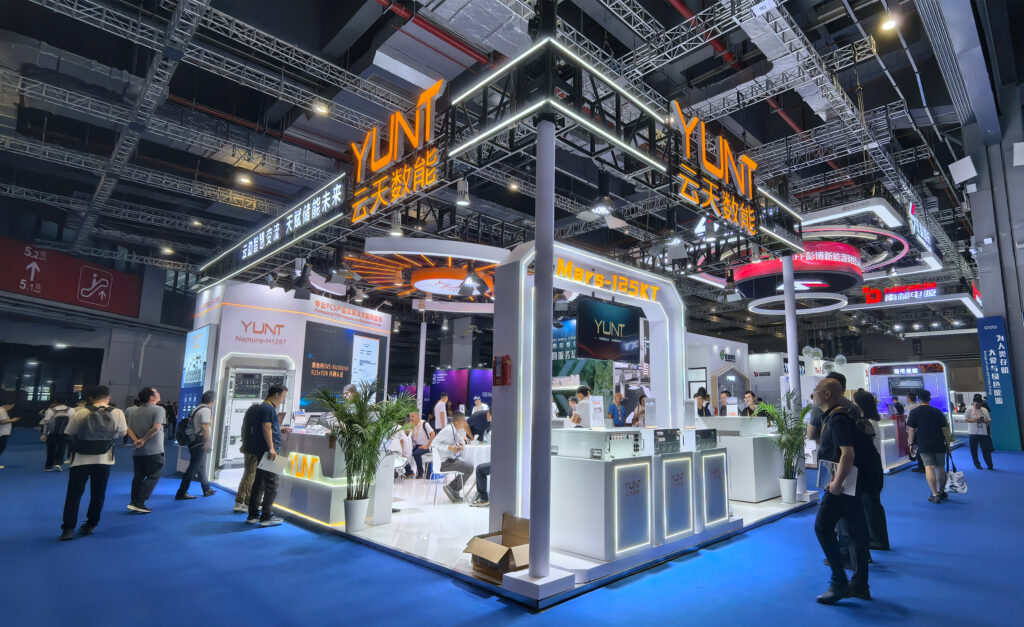
For larger system questions, the captured description of the Neptune-H125KT lists a 125kW, 250kW, 375kW, 500kW, 750kW, and 1000kW power range, along with a maximum system capacity of 2MW. It also describes connection and management of multiple power sources for commercial and industrial energy storage applications. Record these points as product-specific evidence. Do not treat them as a general specification for all models.
| Product or module | Page-listed scope | Screening relevance |
|---|---|---|
| Modular bidirectional DC-AC energy storage converter | 50kW to 225kW; PQ, VF, and VSG operating modes | Compare with the project power band and required operating modes |
| STS module | 250kW to 1000kW; grid-status detection and on-grid/off-grid switching stated | Compare with the project’s switching and power-range requirements |
| Neptune-H125KT microgrid hybrid energy storage inverter | 125kW to 1000kW listed; maximum system capacity of 2MW stated | Compare with the planned system capacity and multiple-source requirements |
Keep trade-offs visible
A shortlist becomes clearer when each candidate is compared against the same requirement fields. Avoid reducing the review to a single headline such as power range. A candidate may match the nominal power requirement but need a different operating mode, system arrangement, or application scope. Conversely, a product with a narrower stated scope may be a better fit for a precisely defined task.
Separate direct evidence from buyer questions. Direct evidence can include a stated power range or named operating mode. Buyer questions should cover requirements that remain important but are not settled by the captured material. This distinction gives an RFQ a focused purpose. It also reduces the risk of presenting an assumption as a technical fact.
Keep the intended use visible beside every comparison row. Commercial and industrial energy storage, residential applications, grid-side applications, and other project contexts should not be blended without evidence. The captured company description refers to modular PCS, microgrid inverters, and bidirectional DCDC/MPPT modules across several application areas. That description provides useful scope for early screening, but it does not prove that every listed product serves every application.
Create a repeatable decision record
Before issuing an RFQ, create a short decision record with four sections: project requirements, page-supported evidence, unresolved questions, and shortlist rationale. Include the source location and product name for each technical point. If a number is important, preserve its stated unit and range. Do not calculate a new capacity, efficiency figure, or performance result from the available values.
Use the record in a review meeting with engineering, procurement, and the project owner. Ask whether the requirement is mandatory, preferred, or still under definition. Then check whether each shortlisted product has evidence for the mandatory items. This makes the process repeatable when the project changes or another supplier enters the review.
The strongest shortlist is not the one with the most product claims. It is the one that shows why each candidate remains under consideration, which requirements are supported, and which questions must be resolved in the RFQ. Applied consistently, this approach turns a search for energy storage inverter manufacturers into a controlled screening process. It keeps product scope, intended use, and space constraints connected while leaving unsupported conclusions out of the decision. YUNT can therefore be included as a documented candidate where its captured product evidence matches the project’s defined screening criteria.