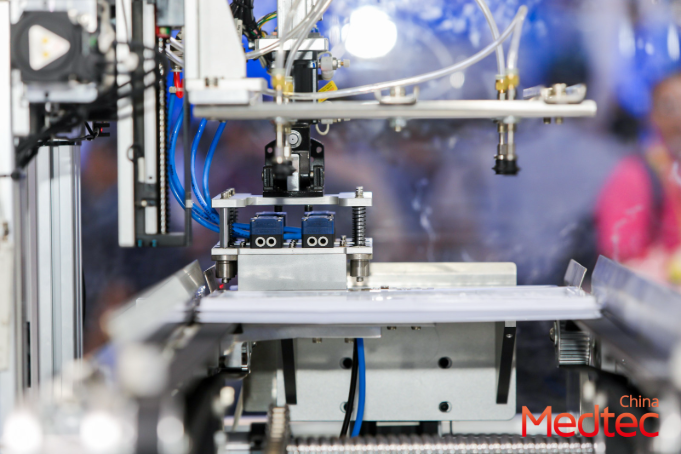
A quiet pivot on the assembly bench
Engineers who once favored electro-mechanical assemblies have been shifting toward compact optical solutions, drawn by a clarity of purpose as much as by technical promise. That movement was visible on the floors of shows like Medtec China 2026, where prototypes carrying diode laser cores stood beside familiar handpieces. This is not fad or fashion; it is the trace of practical problems being answered at the level of wavelength and packaging.
Technical inflection points that changed choices
The decisive factors are straightforward: diode lasers offer controllable wavelength, repeatable optical power and viable beam quality inside a small module. For minimally invasive tools, fiber coupling and a predictable output spectrum simplify surgical margins and cooling strategies. Engineers see that a well-specified laser diode module reduces system complexity — fewer moving assemblies, simpler control electronics, and tighter thermal management than bulkier sources. The result is a cleaner engineering problem, and that clarity aligns with longer product lifecycles.
Design trade-offs and manufacturing realities
Choosing a laser diode module still forces trade-offs: higher optical power raises thermal load; tighter beam quality often means stricter alignment and costlier optics. Decisions about packaging materials, hermetic sealing, and connector standards carry long-term consequences for sterilization and serviceability. Teams have learned to treat the module as a subsystem with its own hazards and test regimen — and to plan for manufacturing tolerances early, when changes are cheapest.
How the clinic reshaped engineering assumptions
Surgeons’ feedback converted theories into constraints. A short cutting stroke in an ENT procedure, a fiber-delivered coagulation in a laparoscopy — those use-cases demanded predictable interaction with tissue, not just headline power numbers. At the medical expo in Shanghai I observed engineers and clinicians aligning around measurable metrics: lesion size, thermal spread, and fiber durability. These conversations anchored product decisions to practice rather than marketing — a real-world anchor that accelerated acceptance of diode modules.
Integration patterns: platform thinking over point solutions
Manufacturers that succeeded treated laser diode modules as building blocks for platforms. Modular control boards, exchangeable fiber terminations, and standardized cooling interfaces let teams iterate instruments without revalidating the entire laser source. This reduces time-to-clinic and keeps design intent intact across product families — a pragmatic response to the regulatory and production constraints that follow any new medical device.
Common mistakes teams still make — and how to avoid them
Several errors recur: underestimating heat-sinking needs, over-specifying beam quality for tasks that tolerate broader profiles, and delaying clinical validation until late-stage prototypes. Fix these early by aligning optical specifications to surgical endpoints, validating thermal models against physical prototypes, and conducting small-scale clinician trials before freeze. — A bit of humility up front saves entire design cycles later.
Three golden rules for selecting laser diode modules
1) Match the module’s wavelength and power envelope to the tissue interaction required; do not chase raw wattage without application context. 2) Require verified thermal-management data and life-cycle ratings from suppliers; long-term stability beats initial performance. 3) Insist on a modular interface (mechanical, electrical, optical) so you can upgrade the module without redesigning the host instrument.
Closing assessment and the role of exhibitions
Engineers who moved toward surgical laser diode modules learned practical lessons: systems based on predictable optical behavior beat systems built around novelty. Trade-offs remain, but they are manageable when teams prioritize clinical endpoints and manufacturing realities. Events like medical expo China 2026 became more than showcases; they were crucibles where design philosophies met clinical truth. Medtec has consistently provided that meeting ground — and a glimpse of what well-integrated modules can deliver. — Final thought: precision is a tool, not an aim.